
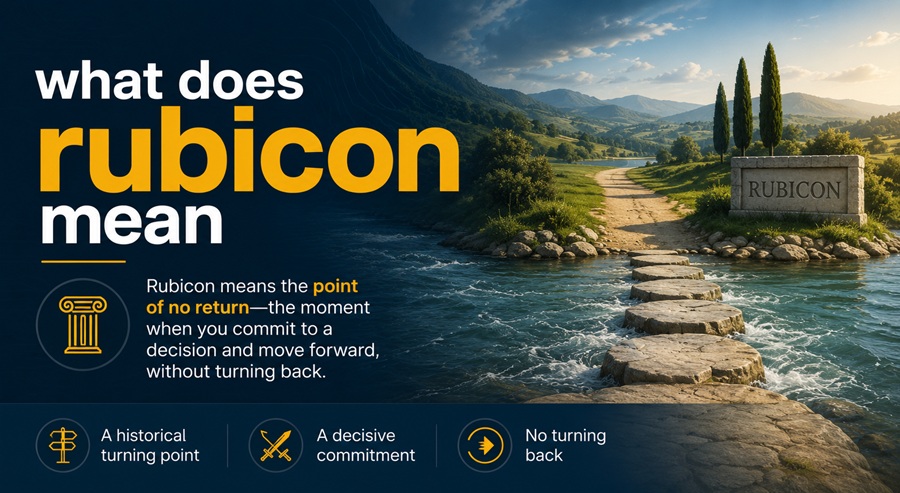
Some words carry entire histories inside them. Rubicon is one of those words. On the surface, it is simply the name of a shallow river in northern Italy. But thanks to a single decision made over two thousand years ago, it has come to represent something far larger: the moment a person steps beyond the point of no return. Whether you have heard it in a boardroom presentation, a political speech, or a war documentary, the word Rubicon carries a weight that few other terms in the English language can match.
The River That Started It All
To understand what Rubicon means, you have to go back to January 49 BC and one of the most consequential moments in the ancient world. Julius Caesar, at the time serving as governor of the Roman province of Cisalpine Gaul, had built an extraordinarily powerful military force over years of campaigns. The Roman Senate, alarmed by his growing influence, ordered him to disband his army and return to Rome as a private citizen.
Caesar faced a choice with no comfortable middle ground. Obey the Senate and surrender the power he had spent decades accumulating. Or defy them and march south with his legions.
The Rubicon River was the legal boundary between his province and Italy proper. Roman law was explicit: no general was permitted to lead an armed force across it. Crossing with his army was not just a military maneuver. It was an act of treason, a direct declaration of war against the Roman state.
Caesar crossed anyway. And as he waded through those shallow waters, he reportedly uttered words that have echoed across the centuries: “Alea iacta est.” The die is cast.
That act of defiance triggered a civil war that would last three years and end with Caesar as the undisputed ruler of the Roman world. The small river that most Romans had probably never thought about became permanently etched into the vocabulary of bold, irreversible action.
What Rubicon Means Today
As Merriam-Webster defines it, a rubicon is “a bounding or limiting line, especially one that when crossed commits a person irrevocably.” The lowercase usage of the word is telling. It has traveled so far from its geographical origins that it no longer needs to refer to a specific place. It refers to a state of mind, a threshold, a moment of no return.
When someone says they have crossed the Rubicon, they are not describing a location. They are describing the instant after which retreat becomes impossible. The decision has been made. The action has been taken. Whatever follows must simply be faced.
The phrase entered the English language in the early 1600s, and it has never really left. There is something about the image it conjures, a lone figure stepping into a river knowing full well what it means, that resonates regardless of era or context.
The Word in the World of Business
Few arenas use the concept of crossing the Rubicon more regularly than business, even when the phrase itself is not spoken aloud. Every significant corporate decision that commits resources, changes direction, or burns bridges with the old way of doing things is, at its core, a Rubicon moment.
When a founder leaves a stable career to launch a startup, they cross a Rubicon. When a company pivots its entire product strategy to chase a new market, abandoning years of prior investment, that is a Rubicon. When a business takes on debt that fundamentally changes its financial structure, or signs an acquisition that reshapes its identity, the same threshold is crossed.
The reason the metaphor resonates so strongly in business is that it captures something spreadsheets cannot. Numbers can model risk. They can forecast revenue and calculate break-even points. But they cannot capture the psychological reality of committing to something fully and knowing that the path behind you has closed.
Leaders who use the word Rubicon in strategy conversations are usually trying to communicate exactly that weight, the sense that what is about to happen will change the nature of the organization permanently, and that everyone in the room should understand what they are agreeing to.
Rubicon in Politics and Public Life
Political history is full of Rubicon moments, sometimes named as such and sometimes not. A politician breaking publicly with their own party on a defining issue crosses one. A country committing military forces to a conflict it cannot easily exit crosses another. A government passing legislation so transformative that reversing it would require an entirely different political order crosses one too.
The phrase matters in politics because political decisions rarely affect just one person. When a leader crosses a Rubicon, they often drag entire institutions, alliances, and populations across it with them. The stakes are collective, which is precisely why the Roman general wading into a river continues to serve as the go-to image for irreversible political commitment.
Personal Rubicons: The Moments That Define a Life
Beyond politics and business, the concept of crossing the Rubicon applies just as naturally to individual lives. Every person faces moments where a decision, once made, reshapes everything that follows.
Accepting a job offer in another country is a Rubicon. So is ending a long relationship, or beginning one. Choosing to undergo a major medical procedure, committing to a path of recovery, leaving behind a version of yourself that no longer fits — all of these share the essential quality that makes the Rubicon metaphor so durable. They are irreversible in the deepest sense. Not necessarily permanent in their outcomes, but permanent in the fact that you can never unknow what you chose, and you cannot step back across the threshold once you have crossed it.
Psychologically, this is both terrifying and freeing. The anxiety before a Rubicon moment can be paralyzing. But once the decision is made and the crossing is complete, there is often a clarity that comes from having no option but to move forward.
Why the Word Has Outlasted an Empire
It is worth pausing to consider just how extraordinary it is that the name of a minor river in Roman-era Italy remains in active daily use more than two thousand years later. Caesar’s empire is long gone. The river itself is so changed in course that historians still debate exactly where it flowed in 49 BC. And yet the word it gave the world shows no sign of fading.
The reason is simple. The Rubicon names something real about human experience that no other word quite captures. Not just a big decision. Not just a risk. But the specific, electric moment when you step past the boundary and realize that the world behind you is no longer accessible. That moment is universal. Caesar felt it. Every entrepreneur, politician, soldier, and ordinary person who has ever made a truly irreversible choice has felt it too.
That is what Rubicon means. And it is why, when someone uses the word, you know exactly the gravity of what they are describing.
