
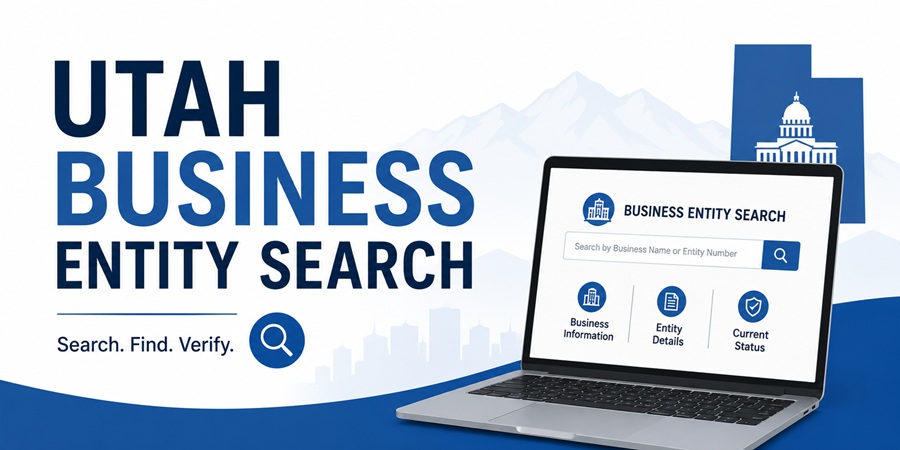
Whether you are launching a new business in Utah, conducting due diligence on a potential partner, verifying that a company is legally registered, or simply checking whether your chosen business name is already taken, the Utah business entity search tool is the place to start. It is free, publicly accessible, and maintained by the Utah Division of Corporations and Commercial Code, the state agency responsible for all business registrations in Utah. Understanding how to use it efficiently, what information it contains, and what it cannot tell you will save you time and help you make better-informed decisions.
Where the Utah Business Entity Search Lives
The Utah Division of Corporations and Commercial Code operates its database through the official state portal at corporations.utah.gov. From there, users can access several distinct search tools, each designed for a different purpose. The Business Entity Search allows you to look up any business registered with the Division by name, entity number, or registered agent. The Business Name Availability tool lets prospective business owners check whether a name they want to use appears to be available before filing. The Registered Principal Search surfaces all businesses associated with a particular individual. There is also a Trademark Search and a UCC and CFS filing search for those with more specific legal or commercial needs.
All of these tools are accessible at no cost for standard searches. The one exception worth noting is the executive name search, which requires a $3 fee to search for businesses associated with a specific individual by name. For most general purposes, the free search tools cover everything the average user needs.
How to Run a Business Entity Search
Using the Business Entity Search is straightforward. Navigate to the search page through the Division of Corporations portal, enter a business name or entity number, and submit your query. The system supports partial name matches, which is useful when you are not certain of the exact registered name of a business.
When searching for name availability, the best practice is to search using only a portion of your desired name rather than the full string with designators like LLC or Inc. The Division recommends omitting entity type designators entirely when checking availability since the system compares names without those suffixes. If your desired business name is Redwood Valley Consulting LLC, search for “Redwood Valley” or even just “Redwood” to surface all potentially similar existing registrations. A name is only officially confirmed as available upon final approval of the Division, so even a clean search result is a preliminary indicator rather than a guaranteed reservation.
For each business that appears in results, the search typically displays the entity name, entity type, entity number, registration status, formation date, and registered agent information. From those results you can also access an official Certificate of Existence for any entity that is currently in good standing with the Division.
If you want to confirm name availability by phone before filing, the Division of Corporations can be reached at 801-530-4849, Monday through Friday from 8 AM to 5 PM Mountain Time. Their representatives can confirm whether a specific name would be available and help you navigate the search system if you encounter any difficulty.
What Information the Search Reveals
The Utah business entity search is a genuinely useful transparency tool. Each registered entity’s public record includes its legal name as filed with the Division, its entity type, its assigned entity number, its formation or registration date, its current status, and the name and address of its registered agent.
As the Utah Division of Corporations’ official search portal explains, users can also view principal individuals associated with a business and obtain official Certificates of Existence directly through the search interface, which is a particularly valuable feature for lenders, landlords, and counterparties in business transactions who need to verify a company’s legal standing before proceeding.
The status field is one of the most important data points to check when researching an existing business. An entity can appear in search results with a variety of status designations. Active status means the business is currently in good standing with the state. Delinquent or expired status means the entity has missed required annual report filings. Dissolved or terminated status means the business has been formally ended. Understanding these distinctions matters enormously in a due diligence context. A company in delinquent status may still be operating functionally but has compliance issues that could affect its ability to enter contracts or pursue legal action in Utah.
Entity Types Registered in Utah
Utah’s Division of Corporations handles a wide range of entity types, and the search database includes all of them. The most common are limited liability companies, which are generally the preferred structure for small and medium businesses due to their flexibility and liability protection. Domestic and foreign corporations, both profit and nonprofit, make up another large segment of the database. Additional entity types include limited partnerships, limited liability partnerships, limited liability limited partnerships, business trusts, and series LLCs.
Utah is one of the states that permits series LLCs, a specialized structure where the articles of organization allow for the creation of separate series within a single LLC, each with its own assets, liabilities, members, and management. This structure is used in real estate investment and certain other contexts where asset segregation within a single legal framework is advantageous.
Foreign entities, meaning businesses originally formed in another state that have registered to do business in Utah, are also included in the Division’s database and are searchable through the same interface.
Annual Reporting and Staying in Good Standing
Understanding the ongoing compliance requirements connected to Utah business registration is important for any business owner or anyone researching a company’s standing. The Division of Corporations requires all registered entities including LLCs, corporations, nonprofits, limited partnerships, limited liability partnerships, and limited liability limited partnerships to file an annual report each year.
For LLCs, the annual report is due by the last day of the anniversary month of the entity’s formation. A business formed on March 12 would have its annual report due by March 31 each year. The standard filing fee is $18 for most entity types, with a $5 surcharge applied to online filings through the state portal. A $10 late fee applies if the report is filed after the deadline, and Utah does not grant extensions. Filing the annual report online through the Division’s registration system is the recommended method since it provides immediate confirmation of receipt and allows updates to registered agent information, principal details, and business address in the same transaction.
Businesses that fail to file annual reports can be placed in delinquent status and may eventually be administratively dissolved by the Division. Reinstatement is possible but requires filing all outstanding annual reports and paying accumulated fees. Checking a company’s annual report history through the business entity search is therefore a meaningful indicator of whether an organization has been consistently maintaining its state compliance obligations.
Practical Uses for the Business Entity Search
The Utah business entity search serves different audiences for different purposes, and it is worth understanding the full range of scenarios where it adds value.
For entrepreneurs forming a new business, the name availability search is the logical first step before investing time in branding, domain registration, or marketing materials. Confirming that your chosen name is distinguishable from existing registrations in Utah avoids the frustration of a rejected filing after you have already built your identity around a name that is not available.
For businesses evaluating vendors, partners, or subcontractors, checking the entity search confirms whether a company is actually registered and in good standing in Utah before entering a contract or transferring funds. A company claiming to be a Utah LLC that does not appear in the Division’s database or appears with a delinquent status is a significant warning sign worth investigating further.
For individuals conducting background research on a business, the registered principal search can surface all entities associated with a specific person, which is useful in legal, financial, and investigative contexts.
For lenders, title companies, and parties in real estate transactions, the Certificate of Existence available through the search portal provides a legally recognized confirmation of an entity’s good standing that can be included in closing documents.
Utah’s business entity search is a genuinely powerful public resource. Using it well takes only a few minutes and can reveal information that would otherwise require significant time and expense to obtain through other channels.
